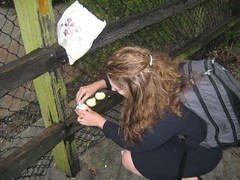
Yesterday, I cookie rolled at The Gap, a popular suicide leaping off point along the Sydney bluffs. The spot was recommended to me by a local, and it was definitely sufficiently dramatic to pay respects to Sisyphus! Unfortunately I was so busy trying to spell that I forgot to make any cookies leap to their demise by pitching them over the fence. Next time!!
For Sydney, I rolled yo yos or melting moments, my absolute favorite cookie in the world. I have been waiting 4 years to eat another one since my first trip to Australia in 2003. I literally ate about 100 yo yo cookies during my 6 week stay then. So far I have eaten 7 in my 2 days in Sydney, which puts me on a similar pace. ^_^
As you can see, I cookie rolled immediately after delivering two back-to-back keynotes, so I am still dressed in my heels and suit and lugging my laptop around in a backpack. Heels on slippery rocks in the rain on unstable bluffs, even with a fence, made it feel like quite the adventure!
But -- I need your help! Please check out this final shot of my cookie rolling word. Can you read it? What do you think it says? Melting moments were a very difficult medium for writing, the cookie is incredibly crumbly so I had to try to carve out the letters in the cream in the middle. It was fun and funny, but I don't know if it's legible! Please check it out and comment here or on flickr with your guess of what the word is. Thanks!
Tuesday, June 26, 2007


Wednesday, June 13, 2007
Sunday, June 10, 2007
Do I have any friends in Barcelona or Sydney?
I'm traveling to Sydney June 25 - 29 and then Barcelona July 5 - 8 and July 16 - 19. I'll be on my own in Sydney and traveling with my husband Kiyash in Barcelona.
I am wondering -- do I have any friends in either city? Maybe we met at a conference or through a game or we've exchanged emails but never met...
Anyway, if you are reading this and you are in either city during that time period, and you are up for a drink or for coffee or for showing a first-time visitor some cool fun place I wouldn't likely stumble onto myself, or even for throwing a Werewolf game, please email me! I'll be cookie rolling both cities, too, yo yos in Sydney and I have no idea what yet in Barcelona, so if you don't know me but want to come roll some cookies with me, that's cool too.
(email me at My first name at avantgame dot com)
Yay!
(This photo is from a trip to Hong Kong in November intended to illustrate how *happy* I would be to find out I have a friend in Barcelona or Sydney!!)

I am wondering -- do I have any friends in either city? Maybe we met at a conference or through a game or we've exchanged emails but never met...
Anyway, if you are reading this and you are in either city during that time period, and you are up for a drink or for coffee or for showing a first-time visitor some cool fun place I wouldn't likely stumble onto myself, or even for throwing a Werewolf game, please email me! I'll be cookie rolling both cities, too, yo yos in Sydney and I have no idea what yet in Barcelona, so if you don't know me but want to come roll some cookies with me, that's cool too.
(email me at My first name at avantgame dot com)
Yay!
(This photo is from a trip to Hong Kong in November intended to illustrate how *happy* I would be to find out I have a friend in Barcelona or Sydney!!)
Thursday, May 31, 2007
Lol dogs
Happy Thursday, everyone. I am having a great week. Unfortunately most of what made it so great, I can't talk about publicly. (The one thing I can talk about is that yesterday I met John Edwards at a private lunch, and he was awesome, squeee.) Instead of blabbing the other good stuff, I offer you my own handmade Lol dogs art. Whee!

Wednesday, May 16, 2007
Think Negative! Play Negative?
John Gravois has an excellent essay in Slate today about The Awesome Power of Negative Thinking. An excerpt:
I'm excited to see such a well-researched critique of our cultural obsession with positive thinking. One of the first things I learned when I joined the Institute for the Future six months ago is the importance of capturing all plausible futures, including the less-than-optimal ones. (I'm now a research affiliate and resident game designer at the non-profit think tank.) The only thing we know for certain is that not all future developments will be desirable ones. To make good decisions in the present, we need to imagine, understand, and evaluate a whole range of future scenarios. Not only the best-case scenarios that pose the most exciting opportunities, but also the the worst-case and mixed-case scenarios that pose the most challenging dilemmas.
As Gravois points out in his essay, we need only think of "the Bush administration, which has been roundly condemned for planning the Iraq war around a set of best-case scenarios.... 'We will be greeted as liberators' was good, but 'Mission Accomplished' was even better. Visualize, guys, visualize! A little negative thinking might have gone a long way in all those situations."
Indeed. I am coming to realize the importance of thinking negatively about these kinds of really big picture, world-changing issues. Global politics is a good place to start. So is the environment and oil dependency.
I may not have explicitly realized this when we first started the project, but it's so obvious now: World Without Oil is at its heart an experiment in negative thinking about the oil dependency issue. Historically, in this respect, is the first game to engage a public collective intelligence (over 35,000 players currently) in explicitly negative thinking about a major social and political issue. (The military and other crisis-response agencies have doing it privately for decades, of course, in things like "war gaming" and "crisis simulations".)
World Without Oil's rather earnest embrace of non-wishful thinking is what really makes this project so risky--and, I think, so important. We're more than two weeks into the live game, and so far a lot of the player-created content is documenting a rather dire alternate reality. You can see explicit fear, pain, and suffering in their creations -- even some apocalyptic undertones. In the first two weeks of play, the game has received over 1000 blog posts, videos, podcasts and other submissions -- and a lot of it is like this letter about separated families in California, this video about rolling blackouts, this blog post about a crumbling IT infrastructure, this voice mail message about taking refuge outside of cities, this video about getting stranded abroad by folded airlines, this video about closed and empty grocery stores, and even this email about civil war.
The latest headlines from the World Without Oil "reality dashboard" mirror the dark aspsects of the reality that the players have imagined and collectively documented. They report: "FUEL RIOTS: Violence Erupts in Seven Cities":
Is there any real benefit to an alternate reality that identifies more problems than it solves? Shouldn't this kind of game try to produce solutions -- and not just detail the myriad and diverse aspects of a potential crisis? This is a question I've asked myself as I've watched the game unfold.
But Gravois' essay and Cerulo's book reveals the importance of telling a compelling story about potentially negative outcomes. Just the act of imagining something other than our desired solution can be a major turning point, a breakthrough. In the case of World Without Oil, players are vividly imaginging something OTHER than the hoped-for scenario in which U.S. easily weans itself off of oil through a combination of alternate fuels and reduced consumption, without any disruption to our country's way of life or any real breakdown of society.
It's not all negative, of course. But the negative is necessary to change the conversation; out of negative thinking, a different - and more realistic - positive effort can emerge. Perhaps the most rewarding part of puppet mastering World Without Oil so far has been to watch the players start to find pockets of optimism - potential ways out - of the "think negative" scenarios they have helped to construct. They have fully embraced a rather dark vision of a future oil shock. Now they are beginning to focus their efforts on generating responses that make the best of the worst-case scenario.
You can really start to see this in action, for instance, in this beautiful web comic about creative transportation "by any means necessary" (it's the seventh in a series of comics by the same player). Or in this fascinating journal entry about the comforts of a new kind of government rationing (the 12th in a series of fictional journal posts from the same player). I adore this series of photo-blog posts about a whole family doing guerilla gardening in their neighborhood. (Just one of many player groups living at least part of their real lives as if the fictional oil crisis were true.) It's really an amazing process to watch overall, and one that I'll look forward to seeing play out over the remaining two weeks of the game, which concludes live play on June 1.
Karen Cerulo, a professor at Rutgers University, wrote a book last year called Never Saw It Coming. In it, she argues that we are individually, institutionally, and societally hellbent on wishful thinking. The Secret [and so much of popular psychology] tells us to visualize best-case scenarios and banish negative ones from our minds. Never Saw It Coming says that's what we've been doing all along—and we get blindsided by even the most foreseeable disasters because of it.
In her research, Cerulo found that when most of us look out at the world and plan for our future, we fuzz out our vision of any failure, fluke, disease, or disaster on the horizon. Instead, we focus on an ideal future, we burnish our best memories, and, well, we watch a lot of your show. Meanwhile, we're inarticulate about worst-case scenarios. Just thinking about them makes us nervous and uncomfortable.
I'm excited to see such a well-researched critique of our cultural obsession with positive thinking. One of the first things I learned when I joined the Institute for the Future six months ago is the importance of capturing all plausible futures, including the less-than-optimal ones. (I'm now a research affiliate and resident game designer at the non-profit think tank.) The only thing we know for certain is that not all future developments will be desirable ones. To make good decisions in the present, we need to imagine, understand, and evaluate a whole range of future scenarios. Not only the best-case scenarios that pose the most exciting opportunities, but also the the worst-case and mixed-case scenarios that pose the most challenging dilemmas.
As Gravois points out in his essay, we need only think of "the Bush administration, which has been roundly condemned for planning the Iraq war around a set of best-case scenarios.... 'We will be greeted as liberators' was good, but 'Mission Accomplished' was even better. Visualize, guys, visualize! A little negative thinking might have gone a long way in all those situations."
Indeed. I am coming to realize the importance of thinking negatively about these kinds of really big picture, world-changing issues. Global politics is a good place to start. So is the environment and oil dependency.
I may not have explicitly realized this when we first started the project, but it's so obvious now: World Without Oil is at its heart an experiment in negative thinking about the oil dependency issue. Historically, in this respect, is the first game to engage a public collective intelligence (over 35,000 players currently) in explicitly negative thinking about a major social and political issue. (The military and other crisis-response agencies have doing it privately for decades, of course, in things like "war gaming" and "crisis simulations".)
World Without Oil's rather earnest embrace of non-wishful thinking is what really makes this project so risky--and, I think, so important. We're more than two weeks into the live game, and so far a lot of the player-created content is documenting a rather dire alternate reality. You can see explicit fear, pain, and suffering in their creations -- even some apocalyptic undertones. In the first two weeks of play, the game has received over 1000 blog posts, videos, podcasts and other submissions -- and a lot of it is like this letter about separated families in California, this video about rolling blackouts, this blog post about a crumbling IT infrastructure, this voice mail message about taking refuge outside of cities, this video about getting stranded abroad by folded airlines, this video about closed and empty grocery stores, and even this email about civil war.
The latest headlines from the World Without Oil "reality dashboard" mirror the dark aspsects of the reality that the players have imagined and collectively documented. They report: "FUEL RIOTS: Violence Erupts in Seven Cities":
Furious mobs smashed windows and set fire to cars across the nation after disclosures that a number of oil company lobbyists were present at last week's closed door hearings on the proposed National Mass Transit Initiative. The Bill's defeat in the House, followed a day later by the announcement of yet another record breaking quarter for 2 of the nation's largest oil companies had left a sour mood in cities struggling without adequate public transportation.
Is there any real benefit to an alternate reality that identifies more problems than it solves? Shouldn't this kind of game try to produce solutions -- and not just detail the myriad and diverse aspects of a potential crisis? This is a question I've asked myself as I've watched the game unfold.
But Gravois' essay and Cerulo's book reveals the importance of telling a compelling story about potentially negative outcomes. Just the act of imagining something other than our desired solution can be a major turning point, a breakthrough. In the case of World Without Oil, players are vividly imaginging something OTHER than the hoped-for scenario in which U.S. easily weans itself off of oil through a combination of alternate fuels and reduced consumption, without any disruption to our country's way of life or any real breakdown of society.
It's not all negative, of course. But the negative is necessary to change the conversation; out of negative thinking, a different - and more realistic - positive effort can emerge. Perhaps the most rewarding part of puppet mastering World Without Oil so far has been to watch the players start to find pockets of optimism - potential ways out - of the "think negative" scenarios they have helped to construct. They have fully embraced a rather dark vision of a future oil shock. Now they are beginning to focus their efforts on generating responses that make the best of the worst-case scenario.
You can really start to see this in action, for instance, in this beautiful web comic about creative transportation "by any means necessary" (it's the seventh in a series of comics by the same player). Or in this fascinating journal entry about the comforts of a new kind of government rationing (the 12th in a series of fictional journal posts from the same player). I adore this series of photo-blog posts about a whole family doing guerilla gardening in their neighborhood. (Just one of many player groups living at least part of their real lives as if the fictional oil crisis were true.) It's really an amazing process to watch overall, and one that I'll look forward to seeing play out over the remaining two weeks of the game, which concludes live play on June 1.
Subscribe to:
Posts (Atom)
